
- f9c913bfe83dbe6a0b64fbd895a4f775 (1).jpg (185.59 KiB) Viewed 1511 times
Piggyback roadkills Diamondbacks. More TRIDENTS Up G.T. 5.31.26
Piggyback roadkills Diamondbacks. More TRIDENTS Up G.T. 5.31.26
Poseidon's Trident: The Symbol of the Sea God's Power and Authority, is here, bestowing his Blessings upon the Mariners.
~
~
Rocky Colavito is a Hall of Famer in my book!
-
Sibelius Hindemith
- Posts: 16606
- Joined: Thu May 02, 2019 3:09 am
- Location: Seattle
Re: Piggyback roadkills Diamondbacks. More TRIDENTS Up G.T. 5.31.26
So if Miller holds the D-backs scoreless through four, what are the odds that Wilson pulls him so that Castillo can pitch 5 and pick up the win? 
Re: Piggyback roadkills Diamondbacks. More TRIDENTS Up G.T. 5.31.26
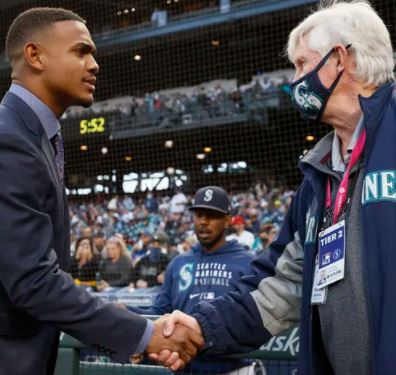
This is odd. What's wrong with this picture?
~
~
One more time:
~
~
- AZ at SEA-GO FOR THREE 2026-05-31.png (94.43 KiB) Viewed 1469 times
One more time:
~
- Trident versus the Snakes.png (344.55 KiB) Viewed 1469 times
Rocky Colavito is a Hall of Famer in my book!
Re: Piggyback roadkills Diamondbacks. More TRIDENTS Up G.T. 5.31.26
What are Castillo's expectations? When the M's leave the field to take their turns at bat in the bottom of the 4th, cameras need to be trained on Luis, for his expressions, demeanor, nervous tics, etc. Might be a humorous study of human psyche. Will Dan be talking to him? Avoiding eye contact? Will La Piedra be warming up?Sibelius Hindemith wrote: ↑Sun May 31, 2026 6:55 pmSo if Miller holds the D-backs scoreless through four, what are the odds that Wilson pulls him so that Castillo can pitch 5 and pick up the win?
Rocky Colavito is a Hall of Famer in my book!
Re: Piggyback roadkills Diamondbacks. More TRIDENTS Up G.T. 5.31.26
Would be cool if it was real. Colt will continue to improve but he's no Griffey.
Rocky Colavito is a Hall of Famer in my book!
Re: Piggyback roadkills Diamondbacks. More TRIDENTS Up G.T. 5.31.26
Tampa Bay, Arizona, Seattle....Which has best philosophy? Best roster construction?
Tampa v Arizona
Here's a side-by-side comparison based on available team stats:High Contact / Low Strikeouts: Rays lead MLB with one of the lowest K% (~18.8%). D-backs sit around 20.4% (also strong). Both teams prioritize putting the ball in play over swinging for the fences.
Solid Plate Discipline (OBP): Rays ~.335–.336 OBP (top-tier). D-backs ~.312–.315 (above average). Both draw enough walks to get on base without excessive strikeouts.
Moderate Power (Not Sluggers): Rays SLG ~.390, ~47 HR. D-backs SLG ~.399–.404, ~48–49 HR. Neither ranks among the league's top power teams—they generate extra bases more through doubles/triples and line drives than homers.
Speed & Aggressiveness on Bases: Rays have ~53 SB (high). D-backs have solid speed too (~37 SB in similar games played), with players like Corbin Carroll contributing triples and steals. Both use legs to create runs.
Batting Average & Overall Production: Rays hit ~.260 (among league leaders). D-backs ~.247–.249. Both score around 4.5–4.7 runs/game—efficient but not explosive.
In short, these are "small-ball 2.0" teams: get on base via contact and walks, advance runners with speed and situational hitting, and avoid the all-or-nothing approach common in power-heavy lineups (e.g., Yankees or Dodgers).Standings ContextRays (AL East): ~35-20, leading or tied atop the division (up ~3 games on the Yankees ). Strong pitching and this contact/speed offense help them win close games and outperform raw projections.
D-backs (NL West): Winning record (~31-25/31-26), but trailing the Dodgers and Padres in a stacked division. Their offense keeps them competitive despite tougher competition.
This style suits both franchises well. The Rays have long embraced data-driven, high-contact approaches under their front office, emphasizing defense and pitching depth alongside it. The D-backs seem to have evolved similarly, with players like Ildemaro Vargas, Ketel Marte, and Corbin Carroll thriving in a contact/speed profile.
Strengths: Sustainable (lower injury risk from chasing power), good in pitcher-friendly parks (Tropicana Field and Chase Field), and deadly in the playoffs when sequencing matters. Low K rates help against elite pitching.
Weaknesses: Can struggle in high-scoring environments or against teams that mash homers. If contact dries up, the offense can go quiet without the power "mulligan" other clubs have.Overall, it's smart baseball that maximizes roster construction—both teams punch above their payroll/HR weight. The Rays' edge in the East looks more secure right now due to division strength, but the D-backs are well-positioned for a Wild Card push if they stay healthy. Fun contrast to the big-power clubs dominating headlines. Anything the M's could do better by learning from these two clubs?
Tampa v Arizona
Here's a side-by-side comparison based on available team stats:High Contact / Low Strikeouts: Rays lead MLB with one of the lowest K% (~18.8%). D-backs sit around 20.4% (also strong). Both teams prioritize putting the ball in play over swinging for the fences.
Solid Plate Discipline (OBP): Rays ~.335–.336 OBP (top-tier). D-backs ~.312–.315 (above average). Both draw enough walks to get on base without excessive strikeouts.
Moderate Power (Not Sluggers): Rays SLG ~.390, ~47 HR. D-backs SLG ~.399–.404, ~48–49 HR. Neither ranks among the league's top power teams—they generate extra bases more through doubles/triples and line drives than homers.
Speed & Aggressiveness on Bases: Rays have ~53 SB (high). D-backs have solid speed too (~37 SB in similar games played), with players like Corbin Carroll contributing triples and steals. Both use legs to create runs.
Batting Average & Overall Production: Rays hit ~.260 (among league leaders). D-backs ~.247–.249. Both score around 4.5–4.7 runs/game—efficient but not explosive.
In short, these are "small-ball 2.0" teams: get on base via contact and walks, advance runners with speed and situational hitting, and avoid the all-or-nothing approach common in power-heavy lineups (e.g., Yankees or Dodgers).Standings ContextRays (AL East): ~35-20, leading or tied atop the division (up ~3 games on the Yankees ). Strong pitching and this contact/speed offense help them win close games and outperform raw projections.
D-backs (NL West): Winning record (~31-25/31-26), but trailing the Dodgers and Padres in a stacked division. Their offense keeps them competitive despite tougher competition.
This style suits both franchises well. The Rays have long embraced data-driven, high-contact approaches under their front office, emphasizing defense and pitching depth alongside it. The D-backs seem to have evolved similarly, with players like Ildemaro Vargas, Ketel Marte, and Corbin Carroll thriving in a contact/speed profile.
Strengths: Sustainable (lower injury risk from chasing power), good in pitcher-friendly parks (Tropicana Field and Chase Field), and deadly in the playoffs when sequencing matters. Low K rates help against elite pitching.
Weaknesses: Can struggle in high-scoring environments or against teams that mash homers. If contact dries up, the offense can go quiet without the power "mulligan" other clubs have.Overall, it's smart baseball that maximizes roster construction—both teams punch above their payroll/HR weight. The Rays' edge in the East looks more secure right now due to division strength, but the D-backs are well-positioned for a Wild Card push if they stay healthy. Fun contrast to the big-power clubs dominating headlines. Anything the M's could do better by learning from these two clubs?
Re: Piggyback roadkills Diamondbacks. More TRIDENTS Up G.T. 5.31.26
LOL its the follow through on the swing silly rabbit....
dt